A 2008 sales-team game, and the physics paper that finally explained it
2026-07-08
In 2008 I ran a game with our regional sales and presales teams at Oracle. I thought it was a lesson about teamwork. A physics paper published this summer finally explained what I'd seen.
Our applications reps and technology reps chased the same accounts on separate quotas. Same company, opposite incentives. As territorial as it gets.
So I put apps on one side and tech on the other, gave everyone cards marked C (cooperate) and D (defect), and reframed the Prisoner's Dilemma. Not prisoners. Two account teams working the same deal. Play C and the account grows. Play D and you win the round but shrink the pie.
We ran several rounds. Trust built. Total value climbed.
Then the last round. One team played D for their own best outcome, exactly what the game rewarded. That one rational move erased most of what we'd built, and the teams finished dead even.
I ribbed the guy who called it for the rest of the fiscal year, joking that he only cared about himself. But he wasn't the problem. The game was, and I had built it too small.
That's what stuck with me. I didn't have the physics or today's language, but I walked out knowing there was a second game sitting on top of the first one.
Three physicists just put numbers to what I watched happen. Their model runs the Prisoner's Dilemma at two levels: individuals competing inside a group, and groups competing against each other. Left alone, a group drifts toward defection. Zoom out, and the groups with more cooperators outgrow the rest.
So the famous lesson, "rational players defect," isn't wrong. It's answering the wrong question.
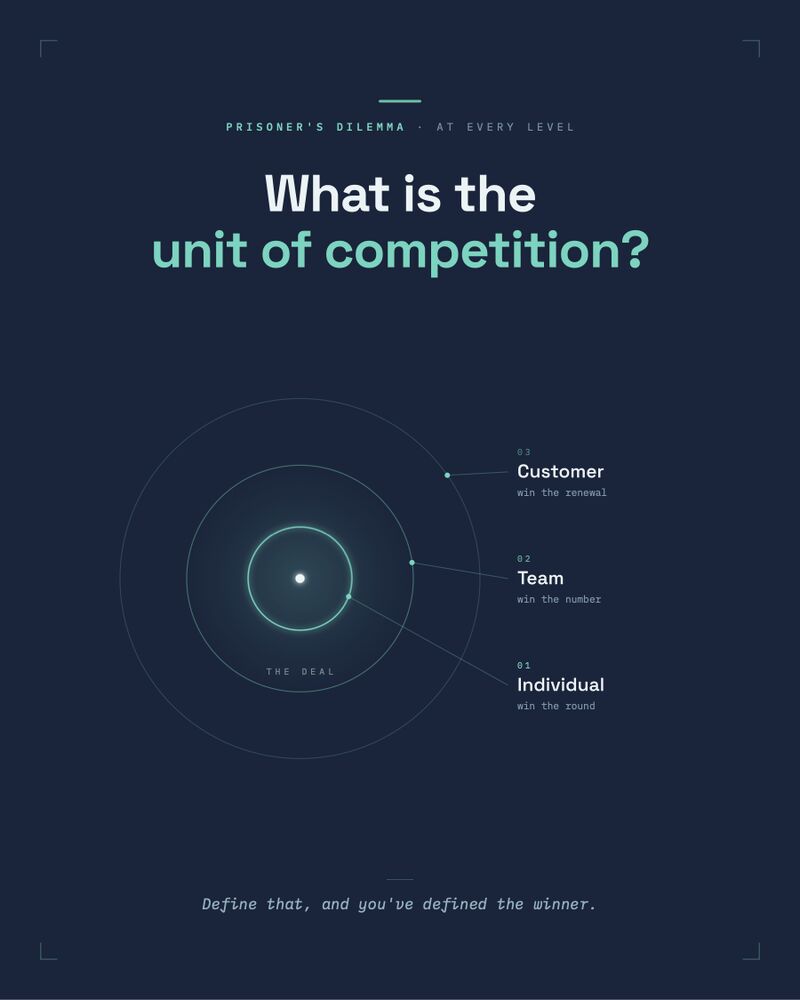
The better question is: what is the unit of competition?
A rep can win the quarter and lose the renewal. A team can hit its number while burning the customer it was hired to serve. A business unit can win every internal fight and still watch the company lose the market.
Selfishness pays locally. Cooperation compounds one level up.
Which means cooperation is something you design for, and something you choose.
Leaders set the payoffs. That's real. But every rep and sales engineer also decides how wide to draw the circle around winning. Their own number. Their team's. The customer's.
Draw it wide enough to include the customer and the three wins line up. The customer gets one account team instead of three silos. The company keeps the renewal. And you build the kind of reputation no single quarter can buy.
Before your next move: what's the widest circle you're willing to play for?
Source: Ispolatov, Simon, and Doebeli, "Evolution of cooperation in spatially structured group-selection models of the continuous Prisoner's Dilemma," arXiv:2606.03071 (June 2026).
Still grateful to the Oracle apps and tech teams who played along in 2008. They taught me more than I taught them.
First published on LinkedIn, 8 July 2026. Lightly revised. Original post.